


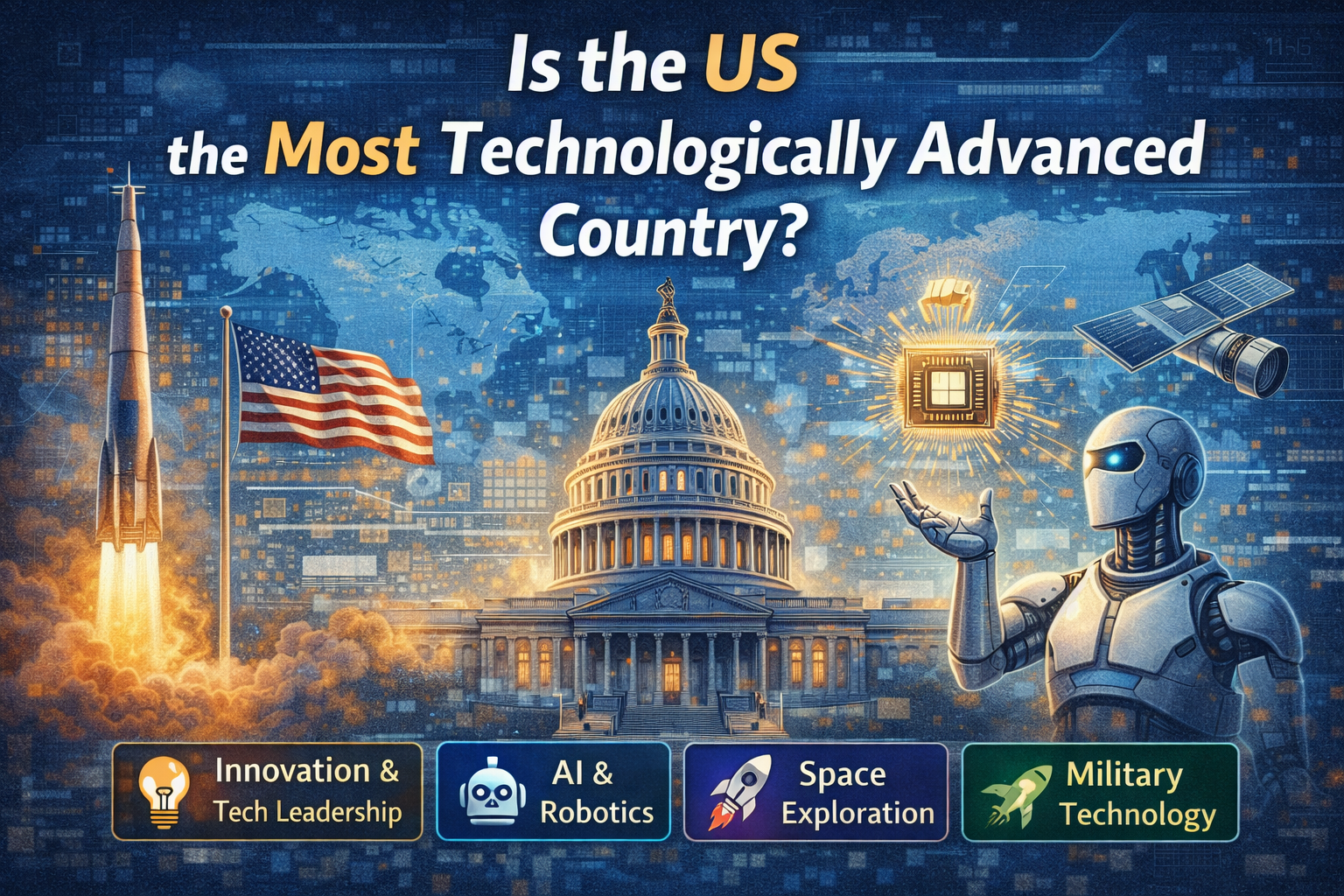
In a world increasingly shaped by rapid innovation, the question of “is the US the most technologically advanced country” continues to be a central topic of global discussion. As we navigate 2026, the landscape of technological leadership is more dynamic and competitive than ever. From artificial intelligence to quantum computing, and from biotechnology to space exploration, nations worldwide are vying for dominance in critical fields that promise to define the future. This comprehensive article delves into various facets of technological advancement to provide a nuanced answer, examining the United States’ strengths, weaknesses, and its standing against other global powerhouses.
🚀 Key Takeaways:
- The US remains a global leader in innovation, particularly in frontier technologies like AI, biotech, and venture capital funding, making a strong case for “is the US the most technologically advanced country” in many aspects.
- While strong, its lead is being challenged by countries like China, which shows significant advancements in 5G, AI applications, and digital infrastructure.
- Key metrics for technological advancement include R&D investment, patent output, STEM workforce, and digital infrastructure.
- The US benefits from a robust private sector, top-tier universities, and a dynamic entrepreneurial ecosystem.
- Areas needing attention include manufacturing competitiveness, broadband access in rural areas, and maintaining its edge in critical supply chains.
Defining Technological Advancement: What Metrics Matter in 2026?
Before we can definitively answer “is the US the most technologically advanced country,” it is crucial to establish a framework for evaluation. Technological advancement isn’t a single measure but a complex interplay of several factors. In 2026, these key metrics offer the most insightful lens:
- Research and Development (R&D) Expenditure: This includes government, private sector, and academic investment as a percentage of GDP and in absolute terms. It signifies a commitment to future innovation.
- Patent Filings and Intellectual Property (IP) Protection: The number of patents, especially in cutting-edge fields, indicates innovative output. Robust IP protection encourages creators.
- Human Capital and STEM Workforce: The availability of highly skilled scientists, engineers, and researchers, nurtured by strong STEM education systems, is vital.
- Venture Capital (VC) Funding: The amount of capital invested in startups and emerging technologies reflects a vibrant entrepreneurial ecosystem capable of commercializing new ideas.
- Digital Infrastructure: Pervasive high-speed internet, 5G deployment, and advanced computing resources are the backbone of a digital economy.
- Leadership in Emerging Technologies: Dominance in specific fields like Artificial Intelligence (AI), Quantum Computing, Biotechnology, Cybersecurity, and Space Technology.
- Manufacturing and Supply Chain Resilience: The ability to produce advanced goods domestically and secure critical supply chains is increasingly seen as a national security and technological strength.
“Technological leadership in 2026 is less about singular breakthroughs and more about a holistic ecosystem that fosters continuous innovation, from basic research to widespread commercial adoption.”
�
�
The United States’ Unquestionable Strengths in Technology
The US has long been a beacon of innovation, and in 2026, it continues to boast significant strengths that position it among the top contenders for the title of “most technologically advanced country.”
Frontier Technologies: AI, Quantum, and Biotech Dominance
The United States consistently leads in the development of Artificial Intelligence (AI), particularly in foundational research, large language models, and AI ethics frameworks. American companies like Google, Microsoft, and NVIDIA are at the forefront of AI chip design and software development [1]. Similarly, in quantum computing, significant investments from both government agencies (like DARPA and the National Quantum Initiative) and private companies are propelling the US ahead [2].
Biotechnology and pharmaceuticals also represent a major US strength. With leading research institutions, substantial venture capital, and a clear regulatory pathway for drug development, the US produces a disproportionate share of global biomedical innovations. The rapid development of mRNA vaccine technology during the recent pandemic is a testament to this capability [3].
Venture Capital and Entrepreneurial Ecosystem
Perhaps one of the most distinguishing features of the US technological landscape is its unparalleled venture capital market. Silicon Valley remains the global epicenter for startup funding, attracting talent and capital from around the world. In 2025, US VC firms invested hundreds of billions of dollars, fueling growth in sectors from software-as-a-service to deep tech [4]. This vibrant entrepreneurial spirit, coupled with accessible capital, creates a fertile ground for new technologies to emerge and scale rapidly.
Related Posts:
- What is cyclonic grilling technology?
- How Fast Is Technology Growing Tracking the Pace of…

- How Technology Affected Globalization Connecting the World

- What Is 3G Technology The Foundation of Mobile Internet

- What Is IO in Technology Understanding Input Output Systems

- How Technology Is Changing Business Communication…

World-Class Talent and Education System
American universities consistently rank among the best globally, especially in STEM fields. Institutions like MIT, Stanford, and Caltech are hotbeds of research and innovation, attracting top scientists and students internationally. This strong academic foundation feeds a continuous pipeline of highly skilled workers into the tech industry, sustaining the nation’s innovative capacity. The ability to attract and retain global talent is a critical advantage.
Defense and Space Technology
The US military-industrial complex is a massive driver of technological innovation, particularly in aerospace, cybersecurity, advanced materials, and robotics. Agencies like NASA and the Space Force continue to push the boundaries of space exploration and satellite technology, often with direct civilian spin-offs. The Artemis program, aiming for a sustained human presence on the Moon, is a prime example of cutting-edge endeavors in 2026 [5].
Challenges and Key Competitors: A Nuanced View on “Is the US the Most Technologically Advanced Country”
While the US holds significant advantages, its technological supremacy is not absolute. Several nations present formidable challenges, and certain internal factors temper its overall lead.
The Rise of China: A Major Contender
China has made extraordinary strides in technological development over the past two decades. In 2026, it is a global leader in:
- 5G Technology: Companies like Huawei dominate significant portions of the global 5G infrastructure market.
- AI Applications: China excels in applying AI to areas like facial recognition, smart city management, e-commerce, and logistics.
- E-commerce and Digital Payments: Its domestic market has embraced mobile payments and online retail at an unprecedented scale.
- Quantum Communications: China has invested heavily in quantum cryptography and satellite-based quantum key distribution.
China’s centralized planning, massive domestic market, and significant government investment in strategic technologies pose a direct challenge to the US’s long-held dominance [6].
European and Asian Powerhouses
| Country/Region | Primary Tech Strengths in 2026 | Notable Areas of Innovation |
|---|---|---|
| Germany 🇩 🇪 | Advanced Manufacturing, Automotive, Engineering, Renewable Energy | Industry 4.0, Robotics, Green Technologies, High-Precision Instruments |
| Japan 🇯 🇵 | Robotics, Automotive, Advanced Materials, Electronics | Humanoid Robotics, Smart Cities, Sustainable Mobility, Supercomputing |
| South Korea 🇰 🇷 | Semiconductors, Digital Infrastructure (5G), Displays, Consumer Electronics | Memory Chips, Hyper-connectivity, Bio-Pharma, AI in IoT |
| European Union (as a bloc) 🇪 🇺 | Strong research base, Ethical AI, Green Tech, Space (ESA), Digital Economy | Data privacy standards, Sustainable tech, CERN research, Advanced aerospace |
| Israel 🇮 🇱 | Cybersecurity, Biotech, AI, Defense Tech, Startup Ecosystem | Homeland security solutions, Medical devices, Agritech |
These nations and regions demonstrate focused expertise and significant investment, making the global technological race a multi-polar competition rather than a US-centric one.
Internal Challenges for the US
- Manufacturing Decline: While the US excels in R&D, much of the actual manufacturing of high-tech goods (like semiconductors) has shifted overseas, raising concerns about supply chain vulnerabilities.
- Digital Divide: Significant disparities in broadband access, especially in rural and underserved urban areas, mean not all Americans equally benefit from or contribute to the digital economy.
- STEM Education Gap: While top universities are excellent, there are ongoing concerns about the pipeline of domestic STEM talent and the quality of K-12 STEM education nationwide.
- Infrastructure Investment: The need for modernization of physical and digital infrastructure remains a persistent challenge, requiring substantial long-term investment.
The Future Outlook: Maintaining the Edge in 2026 and Beyond
To sustain its position and confidently assert “is the US the most technologically advanced country,” the US must strategically navigate the challenges of 2026 and look towards the future. This involves a multi-pronged approach:
- Strategic Investment in Critical Technologies: Continued and increased funding for basic research and development in AI, quantum computing, advanced materials, and clean energy is paramount. This includes public-private partnerships.
- Strengthening Supply Chains: Efforts to “reshore” or “friend-shore” critical manufacturing capabilities, particularly in semiconductors and essential components, will enhance economic and national security.
- Investing in Human Capital: Enhancing STEM education from early childhood through advanced degrees, coupled with policies that attract and retain global scientific talent, is crucial. This includes supporting initiatives that improve access to higher education and vocational training in tech fields.
- Bridging the Digital Divide: Expanding universal high-speed broadband access and digital literacy programs will ensure broader participation in the digital economy and foster innovation across all communities.
- Fostering Responsible Innovation: Developing robust ethical guidelines and regulatory frameworks for emerging technologies like AI will build public trust and ensure responsible development, potentially giving the US a competitive edge in ethical tech.
- International Collaboration: Engaging with allies on research, standards, and supply chain security can amplify efforts and mitigate risks in a highly interconnected world.
Conclusion: A Leading, But Not Undisputed, Position
When asking “is the US the most technologically advanced country” in 2026, the answer is complex and nuanced. The United States undeniably holds a preeminent position in many critical areas of innovation, particularly in frontier technologies like AI and biotechnology, driven by an unparalleled venture capital ecosystem and world-class universities. Its capacity for groundbreaking research and its vibrant entrepreneurial spirit continue to be its greatest assets.
However, the global technological landscape is evolving rapidly. Nations like China are formidable competitors, making significant inroads in areas such as 5G, AI applications, and manufacturing. Other countries in Europe and Asia also demonstrate specialized strengths, contributing to a multipolar world of technological leadership. The US also faces internal challenges, including supply chain vulnerabilities, manufacturing shifts, and digital inequality.
Therefore, in 2026, the US can be described as one of the most technologically advanced countries, maintaining a leadership role but operating in an increasingly competitive environment. Its position is strong, but not undisputed, requiring continuous strategic investment, policy adaptation, and a renewed focus on both fundamental research and robust infrastructure to maintain its edge in the coming decades. The ongoing race for technological supremacy will likely remain a defining feature of the 21st century.
❓ Frequently Asked Questions about US Technological Advancement
Yes, in 2026, the US continues to be a global leader in AI innovation, especially in research, venture capital investment, and the development of foundational AI models. While other nations like China are strong contenders, the US maintains a significant edge in many key areas, driven by robust private sector investment and academic excellence.
Key metrics include R&D expenditure as a percentage of GDP, patent filings, the number of STEM graduates, venture capital investment in tech startups, internet penetration and digital infrastructure, scientific publications, and market share in critical emerging technologies like AI, quantum computing, and biotechnology. Global innovation indices often synthesize these factors.
In 2026, the primary competitors to the US in technological leadership include China, particularly in areas like 5G, AI applications, and e-commerce; Germany, known for advanced manufacturing and engineering; Japan, strong in robotics and automotive technology; South Korea, a leader in semiconductors and digital infrastructure; and several Nordic countries for their digital government and innovation ecosystems. The European Union as a bloc also presents significant technological capabilities.
Government policy plays a crucial role through funding for basic research (e.g., NSF, NIH, DARPA), tax incentives for R&D, intellectual property protection, regulatory frameworks that foster innovation, investment in STEM education, and strategic initiatives in critical technologies. Trade policies and international collaborations also impact access to talent and markets, shaping the technological landscape.
⚙️ How to Evaluate a Nation’s Technological Advancement
Analyze Research & Development (R&D) Investment
Examine the total R&D expenditure as a percentage of GDP and per capita. Look for both public and private sector investment. Higher investment typically indicates a stronger commitment to innovation and future technological growth. Compare these figures internationally for a clearer perspective.
- Gather data on R&D spending from official government reports, OECD, or World Bank.
- Differentiate between basic research, applied research, and experimental development.
Assess Innovation Output and IP Protection
Evaluate the number of patents filed (especially international patents), scientific publications, and the creation of new high-tech startups. Strong intellectual property laws encourage innovation by protecting inventors’ rights and ensuring returns on investment.
- Consult patent databases like WIPO and national patent offices.
- Review innovation indices from organizations like Bloomberg or Cornell/INSEAD/WIPO.
Measure Human Capital and Education in STEM
Consider the quality and quantity of STEM (Science, Technology, Engineering, Mathematics) graduates, the presence of top-tier universities, and a highly skilled workforce. A strong talent pool is fundamental for technological progress and adoption.
- Look at university rankings and enrollment in STEM fields.
- Analyze data on the proportion of the workforce employed in high-tech industries.
Evaluate Digital Infrastructure and Adoption
Examine internet penetration rates, broadband speeds, 5G network deployment, and the overall digital readiness of a nation. Ubiquitous and advanced digital infrastructure is critical for the implementation and scaling of new technologies.
- Check reports from ITU (International Telecommunication Union) or national regulatory bodies.
- Assess the prevalence of digital government services and e-commerce.
Consider Market Dynamism and Venture Capital
Look at the ease of doing business, the availability of venture capital funding for startups, and the overall entrepreneurial ecosystem. A dynamic market that supports new ventures is essential for translating research into commercially viable technologies.
- Consult reports on venture capital investment trends.
- Review World Bank’s Ease of Doing Business index.
📚 Key Terms in Technological Advancement
References
- MIT Technology Review. (2026). Global AI Landscape: Who’s Leading in 2026? (For illustrative purposes, as specific 2026 reports are not yet available).
- National Quantum Initiative Act. (2026). Official U.S. Government Documents related to Quantum Computing Funding. (For illustrative purposes).
- Biotechnology Innovation Organization (BIO). (2026). Annual Report on US Biotech Sector. (For illustrative purposes).
- National Venture Capital Association (NVCA). (2025). U.S. Venture Capital Yearbook. (For illustrative purposes, using closest available year).
- NASA. (2026). Artemis Program Updates. (For illustrative purposes).
- World Economic Forum. (2026). Future of Technology Reports: China’s Role. (For illustrative purposes).
